
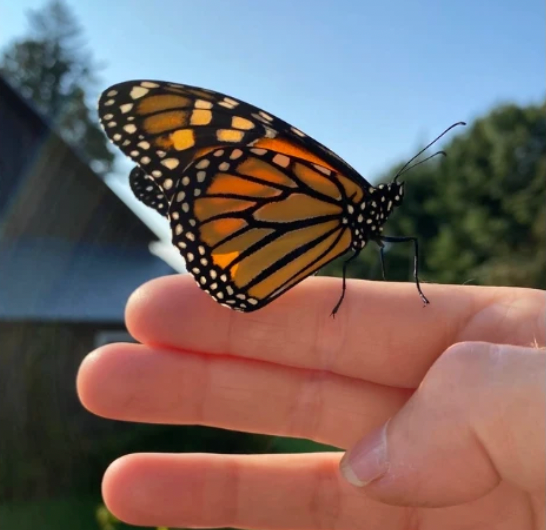
L’incroyable cycle de vie du papillon monarque
Les papillons monarques comptent parmi les insectes les plus remarquables de la nature. Leur transformation, d’un minuscule œuf en un magnifique papillon orange et noir, s’appelle la métamorphose. Cette incroyable aventure se déroule en quatre étapes distinctes.

Le cycle de vie commence lorsqu’une femelle monarque pond un minuscule œuf de couleur crème (généralement) sur le dessous d’une feuille d’asclépiade. L’asclépiade (Asclepias) est essentielle, car c’est la seule plante dont se nourrissent les chenilles de monarque.
Que se passe-t-il?
- L’œuf est à peu près de la taille d’une tête d’épingle.
- Il éclot généralement dans un délai de 3 à 5 jours.
- La minuscule chenille en sort, prête à manger.
Étape 2 : Chenille (larve)
 Après l’éclosion, la principale mission de la chenille de monarque est de manger et de grandir.
Que se passe-t-il?
- La chenille mange presque constamment des feuilles d’asclépiade.
- Elle mue plusieurs fois au fur et à mesure qu’elle grandit.
- Ses rayures caractéristiques noires, blanches et jaunes deviennent plus apparentes à chaque stade de croissance.
Le saviez-vous? Une chenille de monarque peut multiplier son poids corporel par plusieurs milliers avant d’être prête à passer à l’étape suivante.
Étape 3 : Chrysalide (nymphe)
 Lorsqu’elle a atteint sa pleine taille, la chenille trouve un endroit sûr et forme une chrysalide.
Que se passe-t-il?
- La chenille se suspend à l’envers, formant une forme en « J ».
- Elle se débarrasse de sa dernière peau pour révéler une chrysalide vert jade.
- À l’intérieur de la chrysalide, la chenille se transforme en papillon.
Cette étape dure généralement de 10 à 14 jours.
Étape 4 : Papillon adulte

Le papillon adulte émerge de la chrysalide avec des ailes souples et repliées.
Le saviez-vous? Les mâles monarques possèdent deux taches visibles lorsqu’ils ouvrent leurs ailes. Les femelles n’en ont pas.
Que se passe-t-il?
- Le papillon fait circuler du liquide dans ses ailes.
- Ses ailes se déploient et sèchent.
- Une fois prêt, le papillon prend son premier envol.
Les monarques adultes se nourrissent du nectar des fleurs et contribuent à la pollinisation des plantes en se déplaçant d’une fleur à l’autre.

Migration
Les papillons monarques sont célèbres pour leur migration annuelle. Les monarques nés au Canada et dans le nord des États-Unis peuvent parcourir des milliers de kilomètres pour passer l’hiver dans le centre du Mexique. Au printemps, les générations suivantes reprennent le chemin vers le nord.
Comment aider les papillons monarques
Vous pouvez contribuer à soutenir les populations de monarques en :
- Plantant de l’asclépiade indigène dans votre jardin.
- Cultivant des fleurs riches en nectar qui fleurissent tout au long de la saison.
- Évitant les pesticides dans la mesure du possible.
Petit rappel : vous devez détenir un permis pour élever des papillons monarques, de la chenille jusqu’au papillon adulte. Il s’agit d’une espèce protégée et il est illégal de les élever sans permis. Vous pouvez obtenir un permis en cliquant sur le site Web suivant, celui de la Toronto Entomologist Association : https://www.ontarioinsects.org/permit/
Le cycle de vie du papillon monarque nous rappelle de façon magnifique les merveilles de la nature et l’importance de créer des habitats qui favorisent la présence des pollinisateurs dans nos jardins et nos collectivités. 🦋
Excellent site Web pour obtenir plus d’information sur le monarque :



Laisser un commentaire
Ce site est protégé par hCaptcha, et la Politique de confidentialité et les Conditions de service de hCaptcha s’appliquent.